
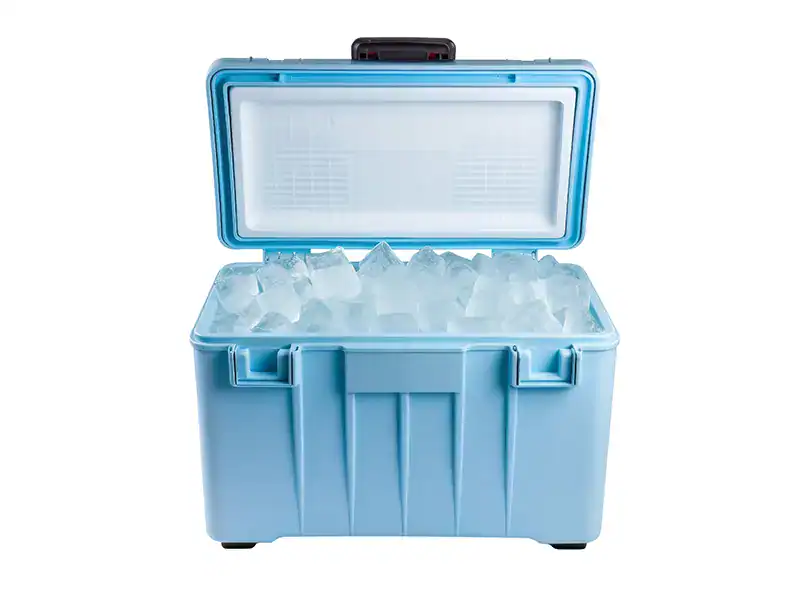
Are you planning a road trip and relying on dry ice to keep food frozen? Getting the amount right can save money, prevent waste, and keep your cooler cold for days.
Too little dry ice and your food may thaw early. Too much and you’re paying for ice that simply disappears into the air. A few key factors make it easy to estimate exactly what you need.
In this guide, you’ll learn how much dry ice to buy, how long it lasts, and the best ways to pack your cooler for maximum performance.
Factors to consider
The right amount of dry ice shifts based on your setup. Keep these factors in mind:
- Cooler size: Bigger coolers have more air space to chill, which burns through dry ice faster.
- Trip length: Requires a fresh calculation every 24 hours. A 3-day trip requires roughly 3 times the effort of a 1-day haul.
- Outside temperature: Summer heat speeds up sublimation. Cooler weather stretches your supply.
- Frozen vs. chilled storage: Keeping items fully frozen demands significantly more dry ice than simply keeping them cold.
- How often you open the lid: Every time you open the lid, cold escapes and warm air enters.
- Food quantity: A full cooler keeps food colder than a half-empty one.
The standard rule for dry ice amount
Don’t overthink it. Use these tested benchmarks:
- Standard 50-quart cooler: Buy 10-15 pounds of dry ice per 24 hours.
- By food weight: Plan for ½ pound of dry ice per pound of frozen food, every 24 hours.
- Warm-weather trips: Lean toward 10-20 pounds per day for serious freezing power.
- Cooler weather: You can often get by with half that amount.
- Chilling only: If you just need food cold (not frozen), you’ll use less than the frozen-food rule suggests.
Example: For a weekend trip with a 50-quart cooler full of frozen meat in mild weather, 20-30 pounds total is a solid starting point.
How fast does dry ice sublimate?
Dry ice doesn’t melt. It sublimates, turning straight from solid into carbon dioxide gas. That’s why it leaves no water behind. But it also means your supply shrinks every hour.
- Daily loss: Expect to lose 5-10 pounds in a quality hard cooler over 24 hours.
- A common rule of thumb: Dry ice sublimates roughly 8% per day under typical conditions.
- 10 pounds of dry ice generally lasts 12-24 hours, depending on outside temperatures.
- Heat and frequent openings speed the loss dramatically.
- Blocks vs. pellets: Solid blocks sublimate more slowly than pellets, making them better for long hauls.
For trips longer than a day or two, carry backup dry ice in a separate cooler so you can top up your food cooler as needed.
Slowing sublimation with better insulation
A few moves go a long way:
- Choose a quality hard cooler. Thick-walled hard coolers hold cold far better than soft coolers, which vent too easily.
- Wrap the dry ice. Cover blocks in newspaper, butcher paper, or a towel to slow sublimation and shield food from freezer burn.
- Fill the empty space. Pack voids with towels or frozen water bottles. Cold air loves to escape through gaps.
- Pre-chill everything. Cool the cooler with regular ice first, and freeze the food before putting it in.
- Keep it shaded. Store the cooler out of direct sunlight, under a table, or in a breezy spot at camp.
- Limit lid openings. Open in short bursts and plan meals, so you’re not rummaging.
Not all coolers can safely handle dry ice. Confirm your cooler is rated for it, and never seal a fully airtight cooler — escaping gas needs a path out.
Where should you place dry ice in the cooler?
Cold air sink, so placement controls whether your food freezes solid or simply stays cold.
- To freeze items: Place dry ice on top. Cold air sinks down through everything below it.
- To keep items chilled: Place dry ice on the bottom with a cardboard or Styrofoam barrier on top.
- Protect the cooler: Always line plastic coolers with cardboard or a towel to prevent extreme cold from cracking the material.
- Build temperature zones: Use dry ice for a frozen shelf of meat, then add a top corner of regular ice for drinks and snacks.
- Keep delicate food away from direct contact. Push produce toward the top to avoid freeze damage.
- Never set cans or bottles on dry ice. The extreme cold can freeze the liquid and burst the container.
Handling & traveling with dry ice safely
Dry ice sits at -109.3°F. It’s a powerful tool that demands respect. Follow these rules:
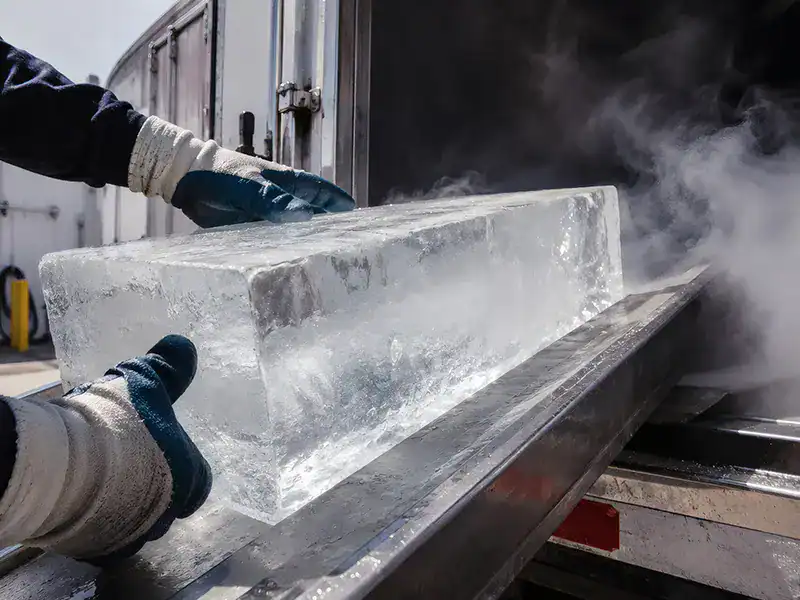
- Wear gloves. Use heavy-duty leather or winter gloves. Bare skin contact causes frostbite fast.
- Never seal it airtight. Carbon dioxide gas must be vented to prevent pressure from damaging the container.
- Ventilate your vehicle. Crack a window while driving, since gas can build up in an enclosed cabin.
- Keep it away from kids and pets. Store it out of reach at all times.
- Don’t chip it with a knife. It can shatter dangerously.
- Dispose of it outdoors. Let leftovers sublimate in a well-ventilated outdoor area. Never dump it in a sink, toilet, or sealed trash can.
Pack smart & travel cold
Dry ice keeps food frozen for days without the watery cleanup of regular ice. Nail the quantity, and the rest falls into place.
Here’s the short version:
- Start with 10 to 15 pounds per 24 hours for a 50-quart cooler.
- Expect to lose 5 to 10 pounds a day to sublimation.
- Wrap it, shade it, and fill the gaps to make it last.
- Place it on top to freeze, on the bottom to chill.
- Always wear gloves and ventilate your vehicle.
Plan your route, pre-freeze your meals, and pack a little extra dry ice for long hauls. With smart packing, you can keep food safe across a multi-day trip without paying for constant ice refills.
FAQs: Dry Ice for Road Trips
Q: How much dry ice for a medium cooler?
You need about 10 pounds per day for a 50-quart cooler in mild weather. In hot conditions, bump that up to 15 pounds or more.
Q: Can dry ice crack my plastic cooler?
Yes, it can. Line the bottom with cardboard or Styrofoam to protect the plastic from the extreme cold.
Q: How long does 10 lbs of dry ice last?
It typically lasts between 12 and 24 hours, depending on outside temperatures and how often you open the lid.
Q: Do I put dry ice on the top or bottom?
Place it on top for rapid freezing, since cold air sinks. Put it on the bottom (with a barrier) to keep food chilled rather than frozen.
Q: Is it safe to drive with dry ice?
Yes, but keep your car windows slightly cracked so carbon dioxide gas can escape and won’t build up in the cabin.
Q: How should I handle dry ice?
Always wear heavy-duty leather or winter gloves. Never touch it with bare skin, as it can cause severe frostbite.
Q: Can I place canned drinks directly on it?
No. Direct contact with the liquid can freeze it and cause cans or bottles to burst.
Q: How do I dispose of leftover dry ice?
Leave it in an open cooler in a well-ventilated outdoor area until it fully sublimates. Never seal it in a bag or place it in a closed trash can.






Leave A Comment